JR East Train Set List
101 series | 101系
201 series | 201系
203 series | 203系
205 series | 205系
207 series | 207系
Description | 説明
East Japan Railway Company/JR East (東日本旅客鉄道株式会社) is one of the seven JR Group companies, which became a spin-off from Japan National Railways. The company service ran on Tokyo, Kanto and Tohoku area, and also stands for Shizuoka area. Each region consists of many lines indicated by different colour code.
The trains used listed as follows:
101 Series | 101系
Services: Nambu Branch Line

101 series is one of the earliest train set used on some lines, including Nambu Branch Line. Its formation used only 2 cars which all of them are motorised, rheostatic controller equipped with motor generator for providing power. The main difference from other 101 family is the cooling system, the Nambu Branch version used 2 cooling box above. Until the debut of 205-1000 series and all 101 series final service on 2003, three formations of this set are operated with one man service indicated by green katakana markings on the front window.
101 Series Formation Table | 101系 編成表


201 Series | 201系
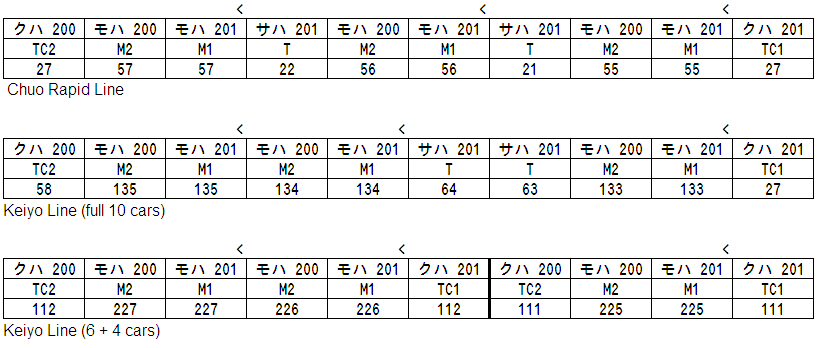
Services: Chuo Rapid Line, Keiyo Line

201 series are built from 103 series mild steel base body with some differences on structure and interior design, with smaller window size on the doors similar like earlier Tokyo Metro train sets. All sets use rheostatic resistor type controlled traction system directly derived from 103 series, and even served as rapid service on the Chuo Main Line. Nowadays, all 201 series on JR East coverage area are already replaced by E233 series train sets, whose some remaining train sets stored or rather scrapped.
201 Series Formation Table | 201系 編成表

203 Series | 203系
Services: Joban Line

203 series are built as successor from 201 series and development base for 205 series train set. Exclusively operated in Joban Local Line, they are slightly different from its predecessor, including stainless steel body, additional advertisement spaces and similarity with Tokyo Metro 6000 series running on the same line. Using chopper traction system, they provide better energy management and performance efficiency rather than 103 series. They're replaced by E233-2000 series afterwards, and some train sets are removed or transferred overseas.
203 Series Formation Table | 203系 編成表


205-0 Series | 205系 0番台
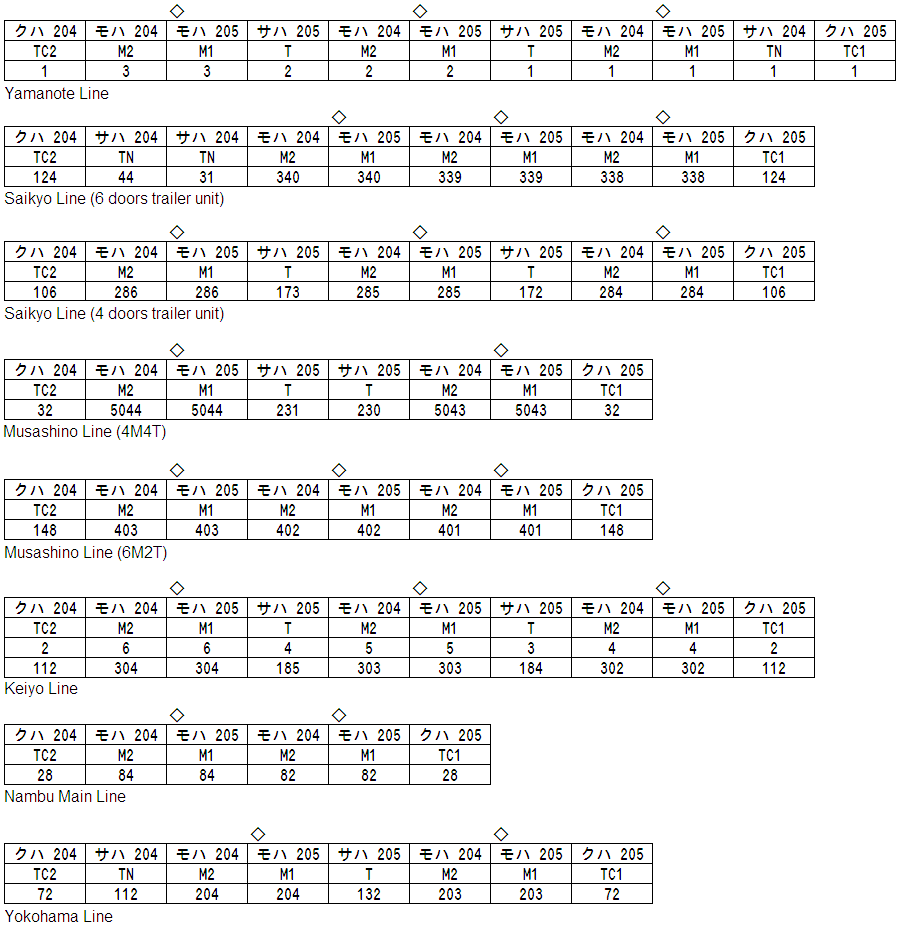
Services: Yamanote Line, Saikyo Line, Musashino Line, Keiyo Line, Yokohama Line, Nambu Line & other lines

205 series are based from design of 203-100 series with same traction type as 201 series, they use rheostatic-controlled type motor but with stainless steel carbody. Some of its properties inside are same like former 203 series, with additional 6 doors prototype that have influence for design of 209-0 series and E231 series 6 doors unit. The first use of 205 series is in Yamanote Line, then replaced by E231-500 series afterwards with gradually transfer to the other JR East lines, including modifications to fit on the each lines occupied. In 2014, some retired-from-service sets transferred overseas for further commuter service, or sold to local third-sector private companies. Some sets have special 6-doors unit to accompany larger size of standing passengers.
205-0 Series Formation Table | 205系 0番台 編成表

207-900 Series | 207系 900番台
Services: Joban Line

207-900 design is heavily influenced by its predecessor 205 series. Rather than using rheostatic controller to serve electric currents, this type used VVVF-GTO with inverter type traction system. Until October 2009, this variant used as first VVVF controlled electric multiple unit prototype-built for JNR with only one set had built. It also bears no relationship with other 207 series built for JR West, inspiring design of E231 series instead.
207-900 Series Formation Table | 207系 900番台 編成表

